
Our Work/Case Study/Business Management
Munshi Ji.
Vyapar ka poora hisaab — a pocket munshi for small manufacturers and traders. Cash in the galla, bank balance, udhaar, stock, production and staff attendance on one phone screen, in the Hinglish the owner already speaks.
(01) — Summary
At a glance.
The owner who still runs on a bahi-khata
Small manufacturers, wholesalers and trading firms where the owner — the malik — wants the numbers without learning accounting software.
Money, credit and stock scattered across books
Cash, udhaar, purchases and stock live in separate registers and in people's heads, so “where do we stand today?” takes an evening to answer.
One phone app that keeps the hisaab
Every sale, purchase, payment and production run is one short entry, and the galla, party balances, stock and reports update on their own.
(02) — Background
Built around the galla.
In a small Indian business the day starts and ends with the cash box. Munshi Ji puts that number first and builds everything else around it.
The malik asks three questions every evening: how much cash is in the galla, who owes us, and what's running low. Munshi Ji answers all three on its first screen.
Owner
Checks cash, bank, money to receive and to pay, low stock and overdue udhaar at a glance.
Counter / accounts person
Records each bikri, kharid, vasooli, payment and kharcha as it happens.
Production in-charge
Logs raw material used and finished goods made, so stock stays right on both sides.
Workers
Marked present or absent each day in Hajiri — no separate attendance register.
(03) — The Problems
Where the hisaab slips.
The everyday gaps in businesses that still run on paper registers, a calculator and memory.
No clear cash position
Cash in the galla, money in the bank and today's sales are worked out by hand, usually only at the end of the day.
Udhaar that's forgotten
Credit given to customers and owed to suppliers sits in a khata nobody re-reads, so payments past their term go uncollected.
Stock found short too late
Nobody knows an item is low until an order can't be filled, and re-ordering happens in a rush.
Production off the books
Raw material going into the machine and finished goods coming out aren't recorded, so stock on paper drifts from stock in the godown.
Software that speaks “accounts”
Accounting tools ask for ledgers, vouchers and journals — language the owner and counter staff don't use.
Reports that stay on one desk
When a partner or the owner is away, sharing the day's numbers means photos of a register or a long phone call.
(04) — Goals
What success looks like.
Today's position in one look
Galla, bank, sales, receivable and payable on the first screen.
Entries in half a minute
Pick the kind of entry, fill a short form, save — no accounting terms.
Udhaar that chases itself
Every party has a credit term, and overdue payments surface on their own.
Stock that matches the godown
Sales, purchases and production all move stock, with alerts before an item runs out.
Reports where people already are
Any report, or the day's summary, goes out on WhatsApp in one tap.
(05) — The Solution
Every entry updates the whole hisaab.
Each problem gets its own screen — and all of them read from the same day book.
The galla, front and centre
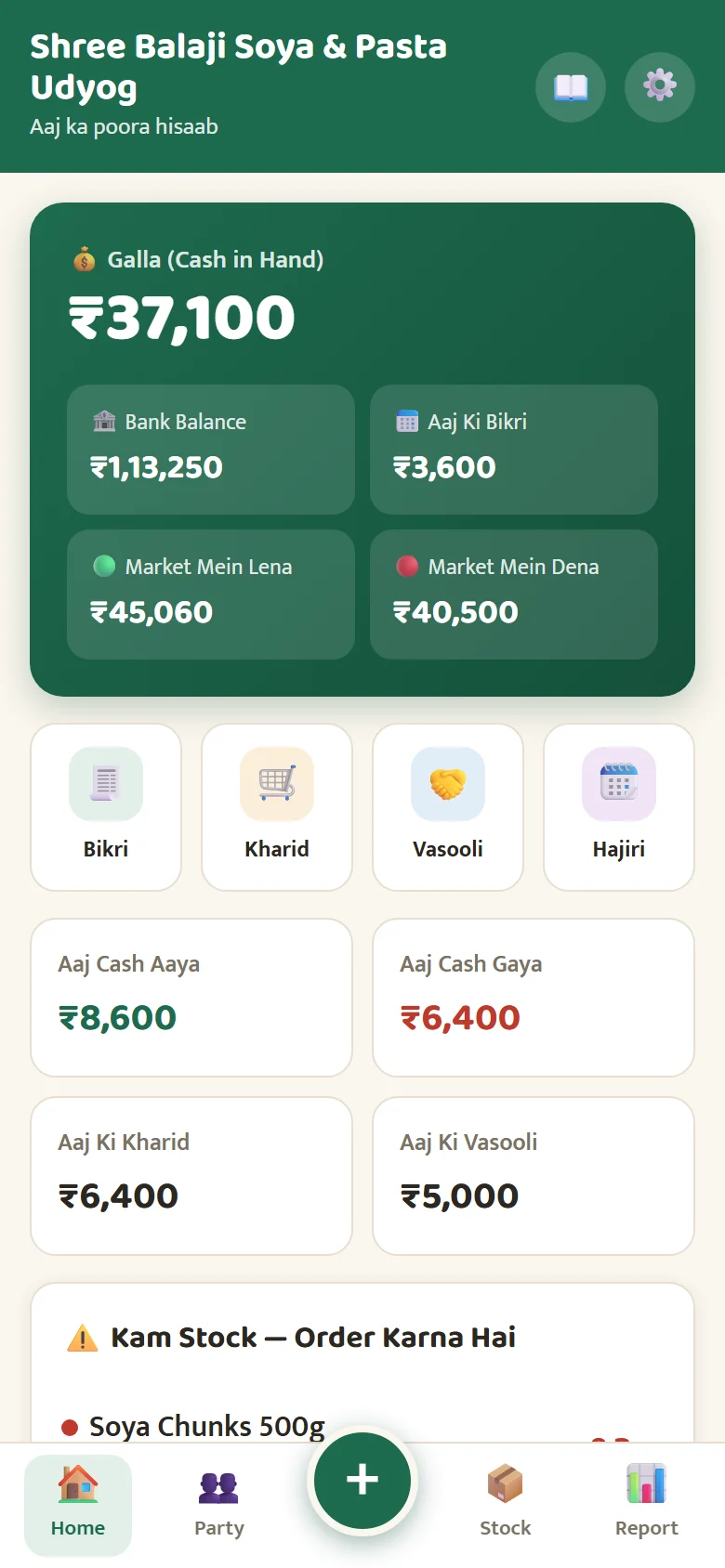
The home screen opens on cash in hand, with bank balance, today's sale and the totals to receive and pay right beneath it. Today's cash in, cash out, purchases and collections follow, then the day's entries.
- Big buttons for Bikri, Kharid, Vasooli and Hajiri
- Low-stock and overdue-udhaar alerts on the same screen
- “Aaj ka summary” sent on WhatsApp in one tap
Eight entries, about thirty seconds each
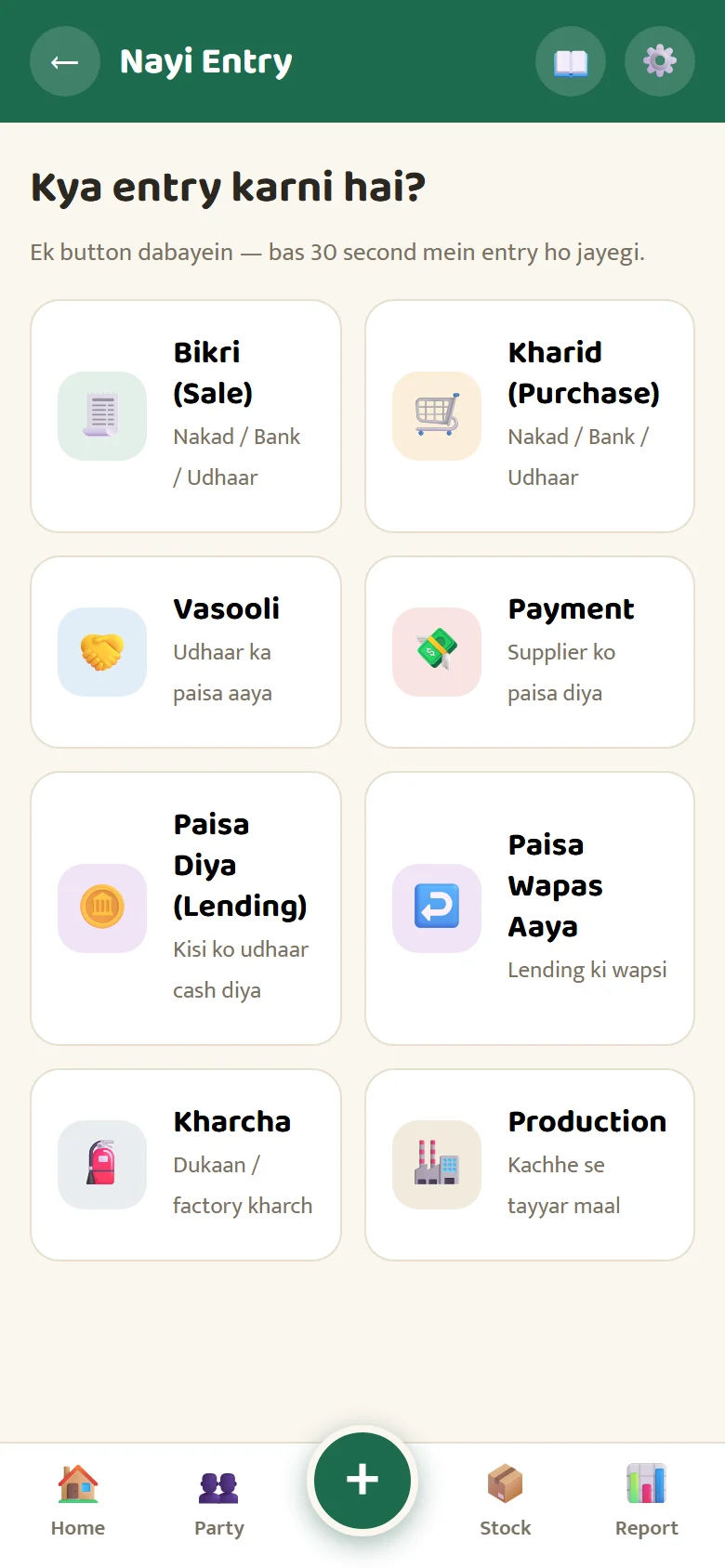
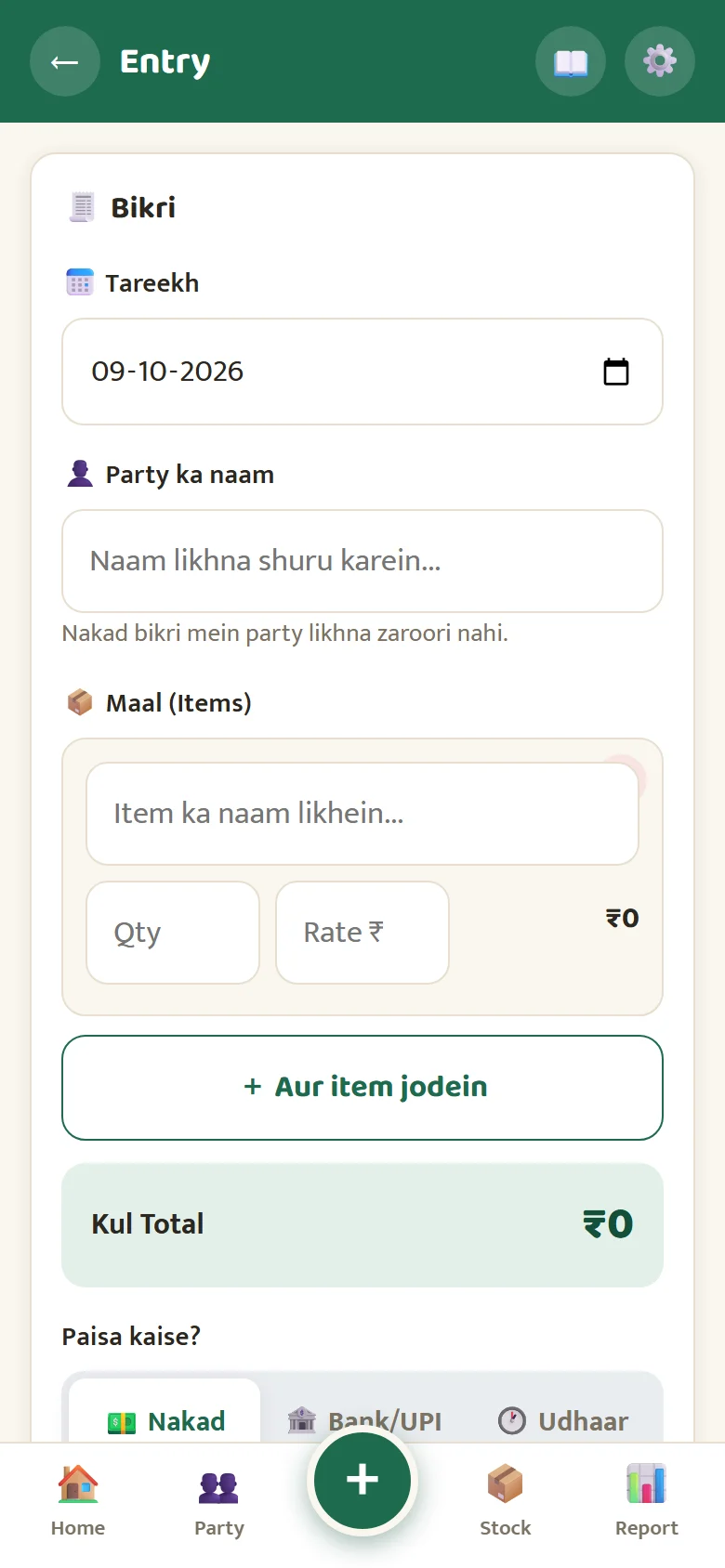
One + button opens every kind of entry in plain words: Bikri, Kharid, Vasooli, Payment, Paisa Diya, Paisa Wapas Aaya, Kharcha and Production. Each form asks only for the date, the party, the items and how the money moved.
- Nakad, Bank/UPI or Udhaar on every sale and purchase
- Several items per bill with a running total
- Party is optional for cash counter sales
A party khata with a memory
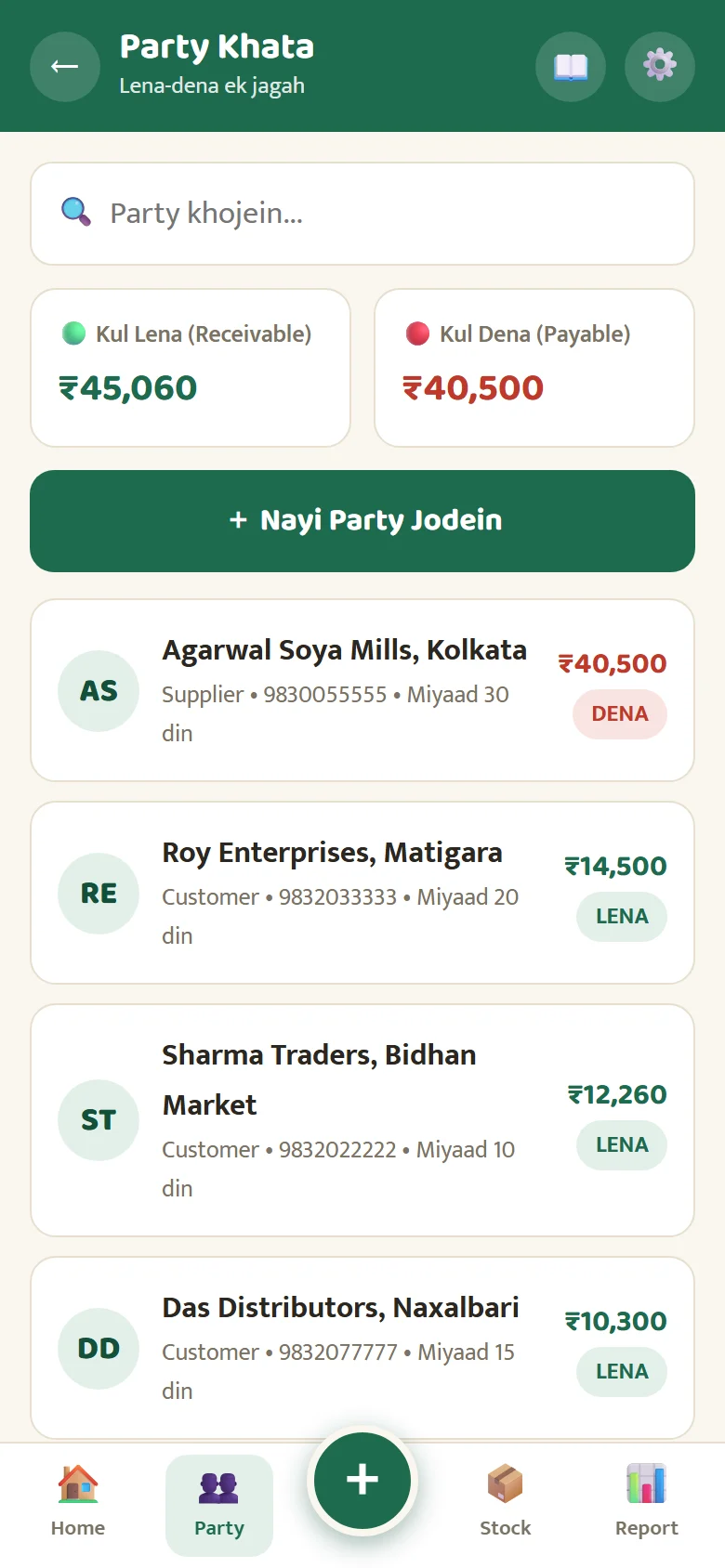
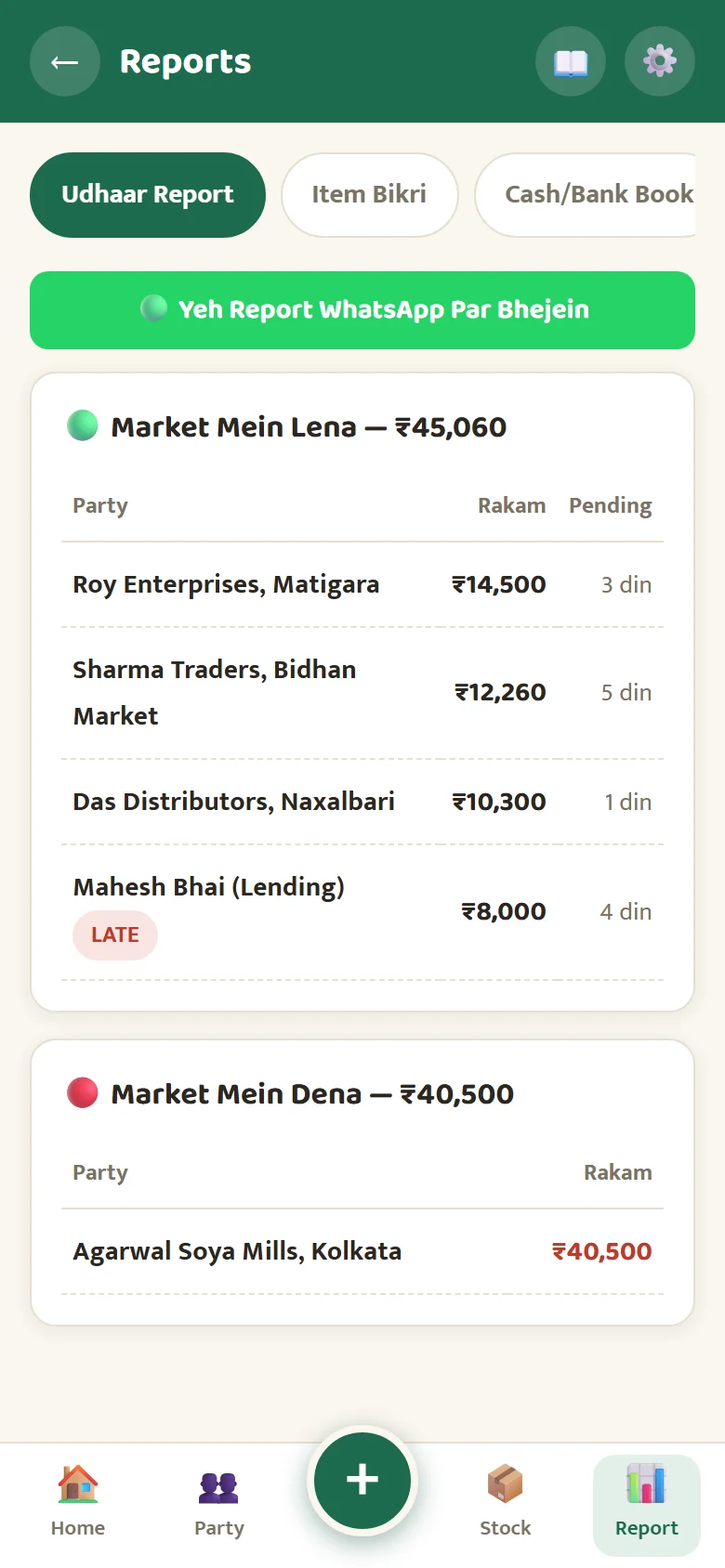
Every customer and supplier has a running balance, a phone number and a credit term — the miyaad. Totals to receive and to pay sit at the top, and the Udhaar Report shows who has been pending how long, with late payers flagged.
- Lena / Dena / Barabar status on every party
- Overdue parties surface on the home screen
- Lending to individuals tracked separately
Godown stock that includes the factory
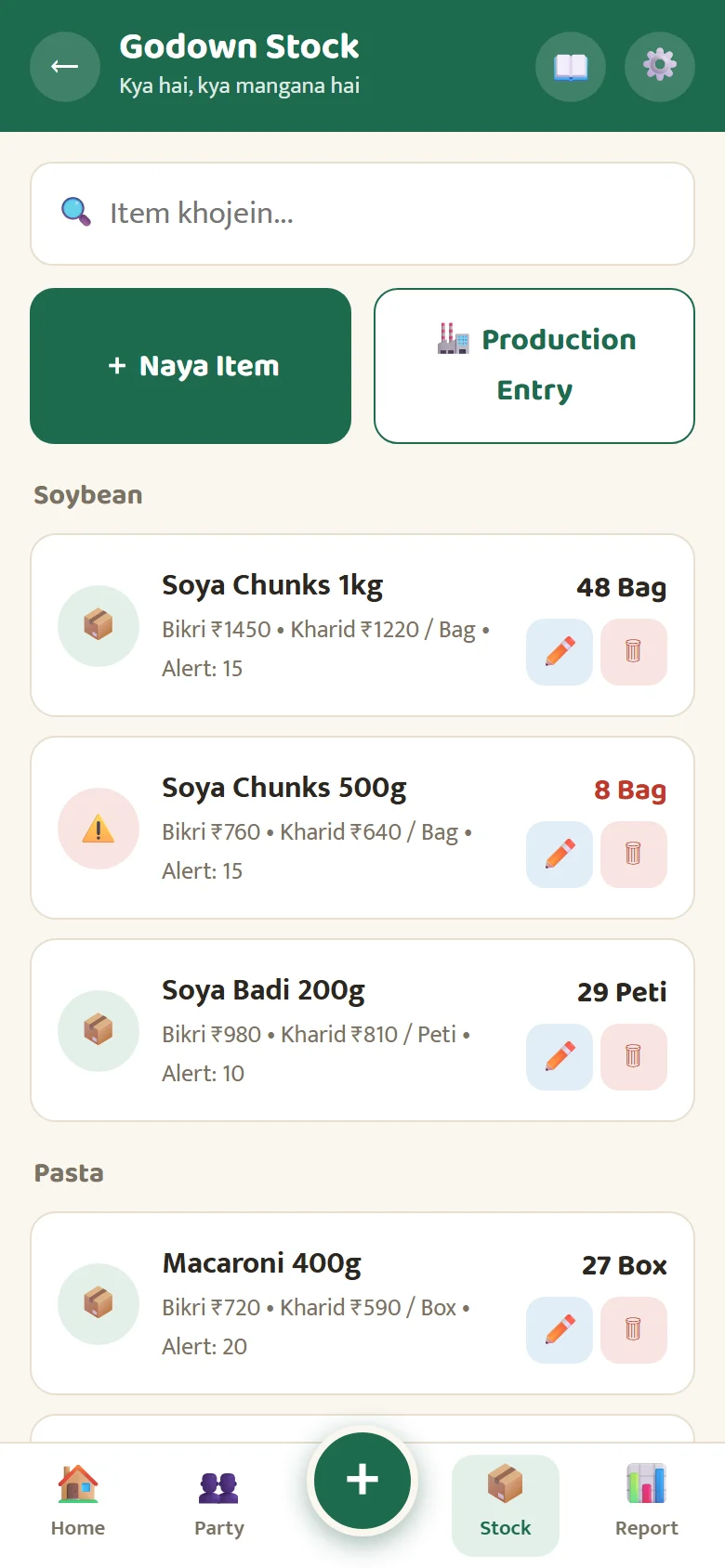
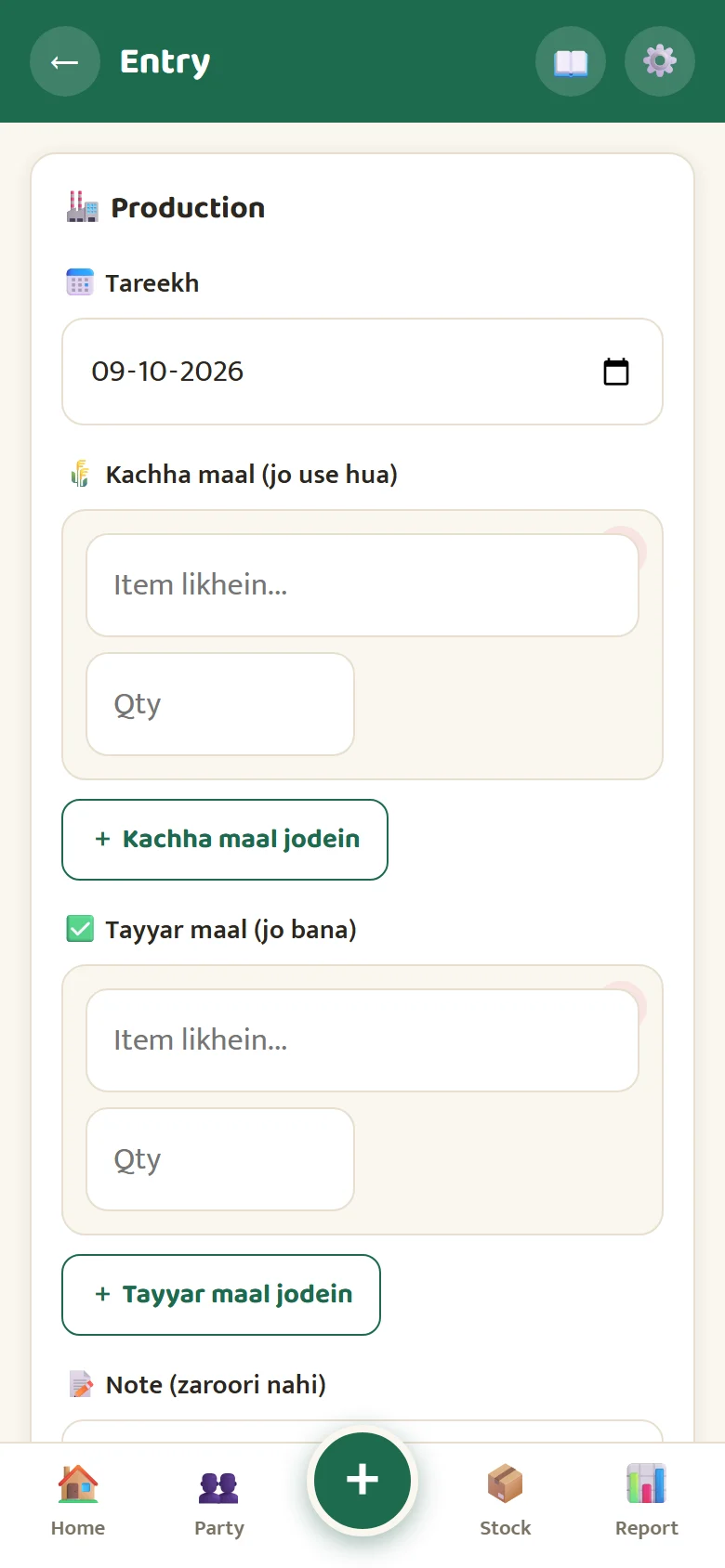
Items are grouped as finished goods and kachha maal, each with its sale rate, purchase rate, unit and alert level. A Production entry takes raw material out and puts finished goods in — so the godown and the books stay in step.
- Bags, peti, boxes or quintals — the unit the business uses
- Items below their alert level highlighted in red
- Raw material used and goods made in one entry
Hajiri
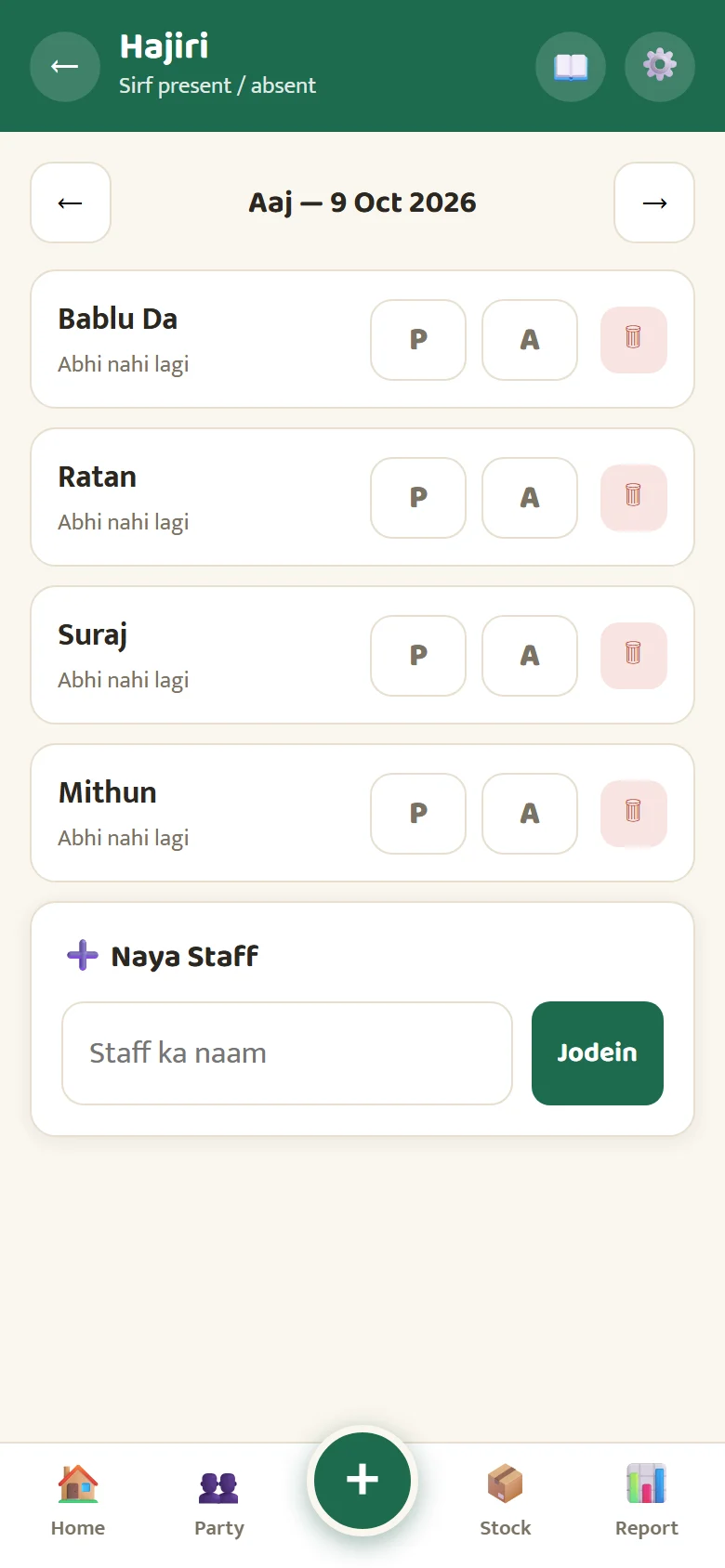
A simple present / absent register for each worker, day by day, with a Hajiri Report alongside the money reports.
Reports
Udhaar Report, Item Bikri, Cash/Bank Book, Lending and Hajiri Report — each one can be sent on WhatsApp from the screen it's on.
Day book
Every entry, in order, with edit and delete — the full record the khata used to be.
(06) — How It Works
Entries in, answers out.
Staff only ever add entries. Everything the owner reads is worked out from them.
A sale on udhaar, for example, adds to today's bikri, raises that party's balance, takes the items out of stock and appears in the day book — from one entry.
(07) — Design Decisions
Choices that keep it simple.
Speak the shop's language
Galla, bikri, kharid, vasooli, miyaad, hajiri — the words on the counter are the words on the screen. No ledgers, no vouchers.
Pick the entry, then fill it
Choosing “what happened” first means each form only asks what that entry needs, which is how an entry stays near thirty seconds.
Put the worry on the home screen
Low stock and overdue udhaar aren't buried in reports — they're on the first screen the owner opens.
Share where the business already talks
Reports go out as WhatsApp messages, because that's where partners, suppliers and family already are.
Treat production as part of the hisaab
For a business that makes what it sells, raw material in and finished goods out belong in the same book as sales and purchases — not in a separate register.
(08) — Conclusion
From bahi-khata to one screen.
Cash, credit, stock, production and attendance kept the way the owner already thinks about them — and the day's numbers ready to send before the shutter comes down.
Gurugram · Plus Offices, Plot 65, Sector 44, Haryana 122003
Siliguri · Jewel Club Lane, Udham Singh Sarani - 734001