
Our Work/Case Study/EdTech · AI
MedPager.
An AI study assistant that reads the student's own textbooks, notes and slides — up to 5,000 pages — and answers from them: structured exam answers in seven sections, a chat that cites the page it used, and MCQs to test what stuck.
(01) — Summary
At a glance.
Students with too many books and too little time
Medical and exam students who must write long, structured answers from huge textbooks and their teachers' notes.
Generic AI answers aren't the syllabus
Chatbots answer from the internet, not from the book the exam is set from — and they don't say where an answer came from.
An assistant that only reads your sources
Upload the material once; every answer, chat reply and MCQ is drawn from it, with the page it came from.
(02) — Background
Exams reward a structured answer.
In medical exams, a long answer is marked on whether it covers the expected headings — introduction, epidemiology, features, investigations, management, complications.
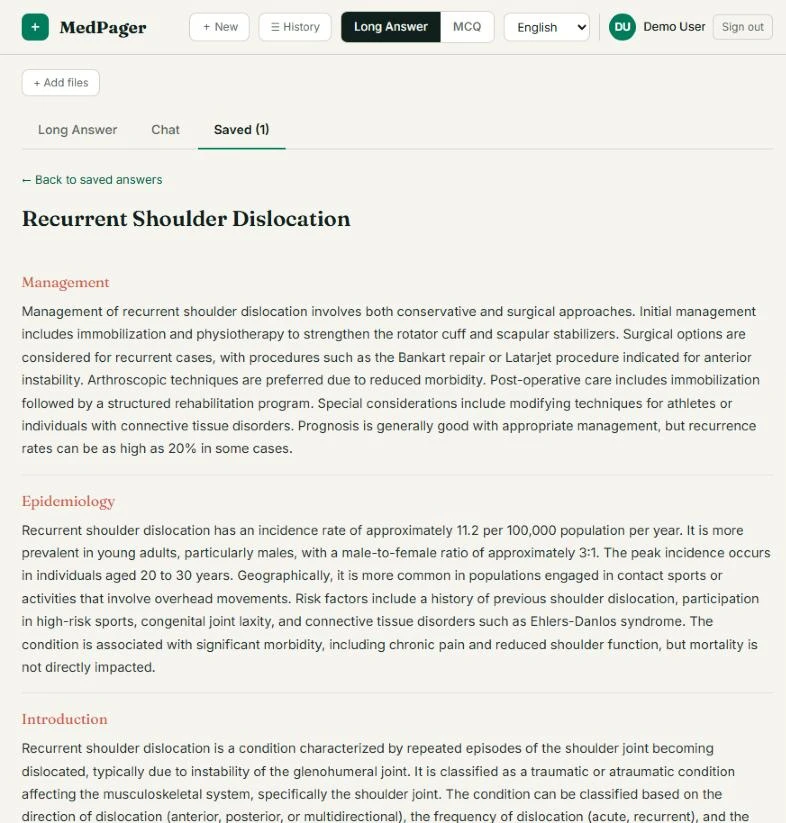
“Write a note on recurrent shoulder dislocation.” The answer is somewhere across three textbooks and a stack of lecture slides — and the exam is next week.
Medical student
Uploads textbooks and notes, asks for long answers and quizzes before exams.
Student studying in their language
Reads answers in Hindi, Bengali, Tamil, Telugu, Marathi or Kannada.
Coaching institute
Can turn its own notes into answers and practice questions for its batches.
Last-minute reviser
Uses chat and saved answers to revise specific topics fast.
(03) — The Problems
Why studying with AI falls short.
The gaps between general-purpose chatbots and how students actually prepare.
Answers from the wrong source
General AI tools answer from the web, which may not match the prescribed textbook.
No way to check
Without a page reference, a student can't verify an answer before writing it in an exam.
Answers without structure
A paragraph of facts isn't the headed, sectioned answer examiners expect.
Books too big to paste
Textbooks run to thousands of pages, far beyond what can be copied into a chat box.
Material in every format
Notes arrive as PDFs, phone photos of pages, Word files and PowerPoint slides.
English only
Many students understand a concept faster in their own language.
(04) — Goals
What success looks like.
Read whole textbooks
Up to 5,000 pages across several files, cross-referenced together.
Answer the way exams mark
Long answers in seven standard sections.
Show the source
Chat answers cite the file and page they came from.
Test, not just read
MCQs generated from the same material, including clinical vignettes.
Study in your language
Answers in English and six Indian languages.
(05) — The Solution
Your books, answered on demand.
Three ways to study — long answers, chat and MCQs — all drawing on the same uploaded sources.
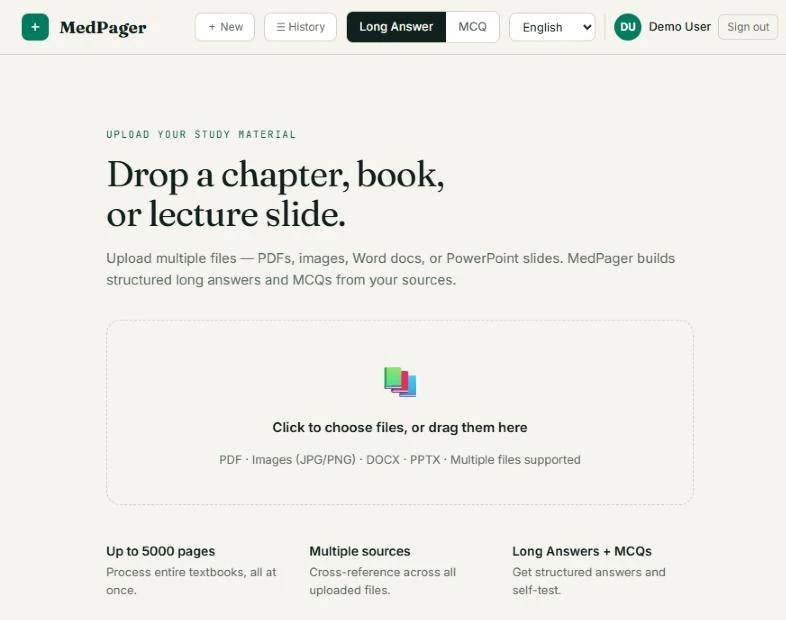
Drop in a chapter, a book or a lecture
Students upload several files at once — PDFs, photos of pages, Word documents and PowerPoint slides — up to 5,000 pages in total. MedPager reads them together, so answers can draw on all of them.
- PDF · JPG/PNG · DOCX · PPTX
- Multiple sources cross-referenced
- More files can be added to a session later
Long answers in seven exam sections
Pick a topic — or let MedPager generate the topic list from the uploaded books — and get a long answer split into Introduction, Epidemiology, Pathological Features, Clinical Features, Investigations, Management and Complications. Answers can be saved for revision.
- Topic list generated from the sources
- The same seven headings every time
- Saved answers kept per session
A chat that shows its page
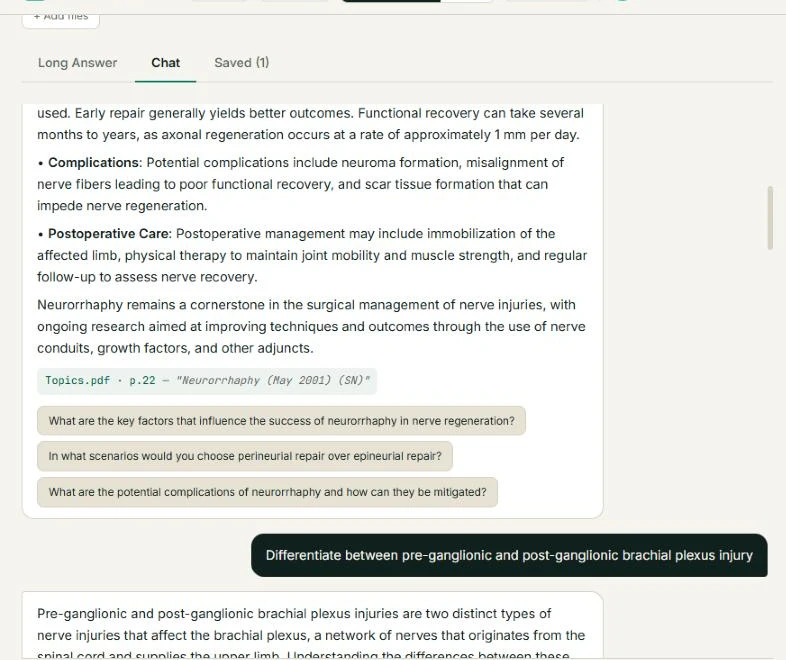
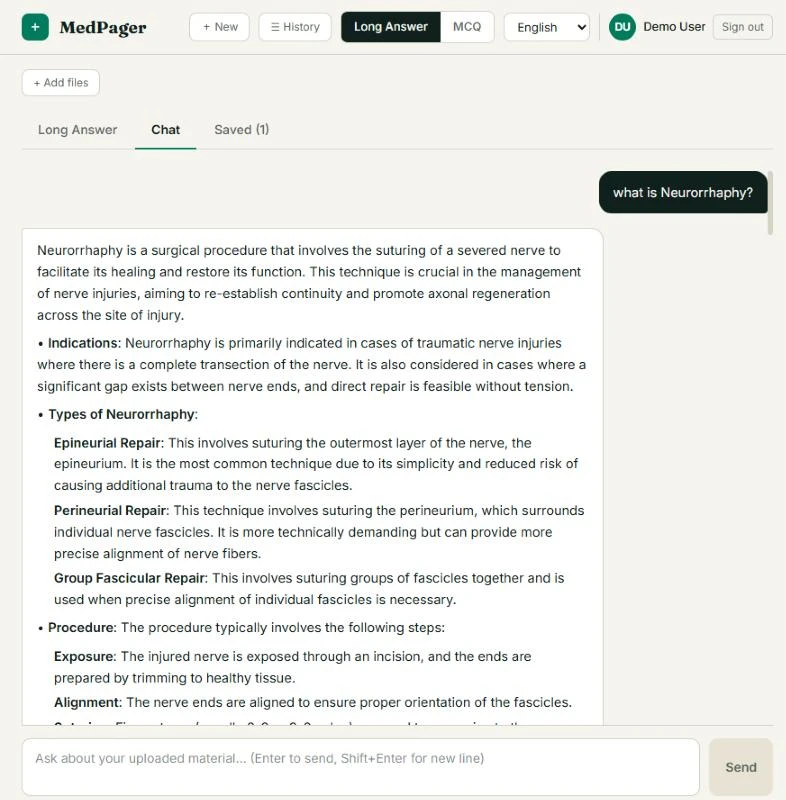
Students can ask anything about their material — “What is neurorrhaphy?”, “Differentiate pre- and post-ganglionic brachial plexus injury” — and get a structured reply that ends with the file and page it came from, plus three follow-up questions to keep going.
- “Topics.pdf · p.22” under the answer
- Suggested follow-up questions
- Answers stay within the uploaded material
Sessions, history and MCQs
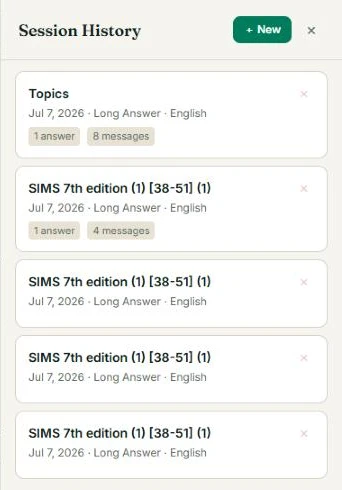
Each upload becomes a session with its answers and chat, listed in history by date, mode and language. Switch to MCQ mode and the same sources become a self-test, with clinical-vignette questions.
- Session history with answer and message counts
- Long Answer and MCQ modes
- English, Hindi, Bengali, Tamil, Telugu, Marathi, Kannada
(06) — How It Works
Upload, ask, revise, test.
One session holds the material and everything learned from it.
A student uploads a topics PDF, asks about neurorrhaphy, and gets an answer that points back to page 22 — then saves a seven-section answer on shoulder dislocation for revision.
(07) — Design Decisions
Choices that make it exam-ready.
Your sources, not the internet
Answers come from what the student uploaded, so they match the book the exam is set from.
Cite the page
A file name and page number under each chat answer lets the student check it before trusting it.
Shape answers like an examiner
Fixed seven-section long answers match how medical answers are written and marked.
Keep the student moving
Suggested follow-up questions turn one answer into a revision path.
Learn in the language you think in
Seven languages, chosen per session, so a student can read a hard concept in Hindi or Bengali and still write the exam in English.
(08) — Conclusion
From a stack of books to answers on demand.
Whole textbooks turned into structured answers, cited explanations and practice questions — from the student's own sources, in the student's own language.
Gurugram · Plus Offices, Plot 65, Sector 44, Haryana 122003
Siliguri · Jewel Club Lane, Udham Singh Sarani - 734001