
Our Work/Case Study/Manufacturing
JJ Fabrications.
A quotation and CRM platform for a uPVC window and door fabricator in Siliguri. Draw the opening, price it from live rate cards and send a branded quotation — while the material cost and the margin stay on the fabricator's side of the table.
(01) — Summary
At a glance.
A fabricator quoting every opening by hand
JJ Fabrications makes and installs uPVC windows and doors, and every enquiry needs a priced, drawn quotation before anything moves.
Each quote is a small engineering job
Size, window type, brand, glass, hardware and colour all change the price — and working it out by hand is slow and easy to get wrong.
A builder that draws, costs and prices
Pick a type and enter the size; the drawing, the material cost, the margin and the customer price all update as you go.
(02) — Background
The quote is the sales pitch.
A homeowner or builder compares several fabricators. The one that sends a clear, drawn, correctly priced quotation first is the one that gets the site visit.
A single flat can mean a dozen openings — sliders, casements, a door, a ventilator — each in a different size. Every one of them has to be drawn, costed and priced before the customer will talk.
Fabricator / dealer
Sets rate cards and margins, sees the pipeline and every quotation sent.
Site & sales staff
Measures openings, builds the quotation and logs leads from every source.
Homeowner or builder
Receives a branded quotation: a drawing, spec and price for each window.
Production
Works from the same specs — profile series, glass, hardware and colours.
(03) — The Problems
Where quotes lose time and money.
The usual way of quoting uPVC — a tape measure, a calculator, a spreadsheet and a word-processor template.
Slow turnaround
Working out profile lengths, glass area and hardware for every opening takes hours, so quotes go out a day or two after the visit.
Pricing mistakes
A missed reinforcement bar or the wrong glass rate quietly eats the margin — and nobody notices until the job is done.
No drawing for the customer
Without a dimensioned elevation, customers can't picture what they're buying, and site measurements get questioned later.
Cost and price mixed together
One spreadsheet holds both what the material costs and what the customer pays, so sharing it is risky.
Rates change, templates don't
Every brand and supplier has its own per-metre rates, and updating them across old templates is never done.
Enquiries fall through
Walk-ins, referrals, ads and WhatsApp enquiries aren't tracked, so follow-ups depend on memory.
(04) — Goals
What success looks like.
Quote on the same day
Enter the opening, pick the options — the quotation is ready before leaving the site.
Every cost counted
Profile, reinforcement, glass, hardware, consumables and labour worked out for every window.
A drawing with every window
A dimensioned elevation, generated from the size and type — no CAD needed.
Margin kept private
Cost and margin visible to the fabricator only; the customer sees a clean price per square foot.
Rates in one place
Brands, glass and hardware priced once in a rate card that every new quote reads from.
(05) — The Solution
From opening size to signed-off quote.
Each step of quoting gets its own screen — all drawing on the same rate cards and design library.
A design library with live drawings
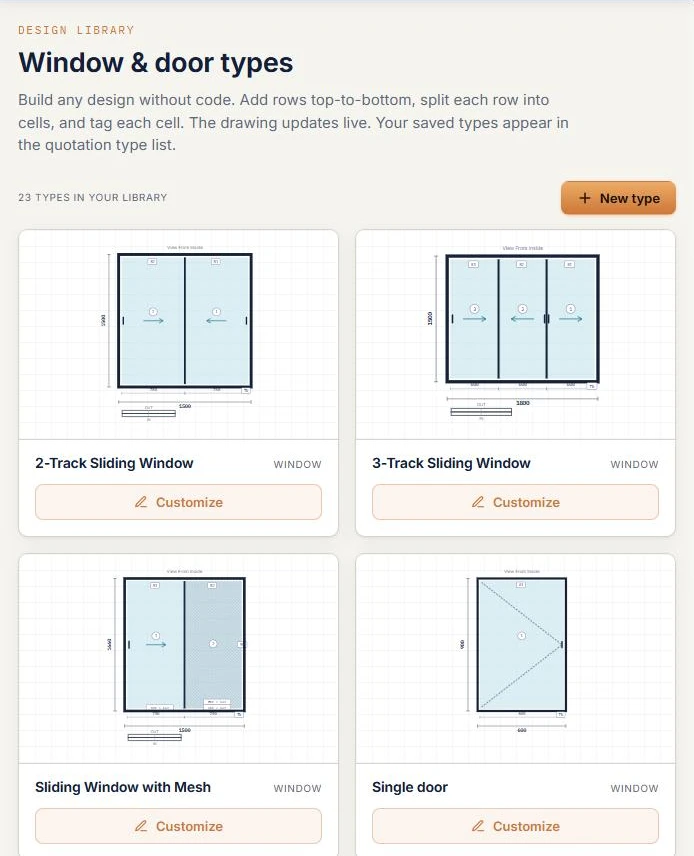
23 ready-made types — sliders, casements, fixed and picture windows, five kinds of arch, doors and ventilators. New types are built without code: add rows top to bottom, split them into cells and tag each cell, and the drawing updates live.
- Sash numbering, sliding direction and dimensions on every drawing
- Composite units — e.g. a louver stacked over a fixed panel
- Saved types appear straight in the quotation builder
Every rupee counted — and kept private
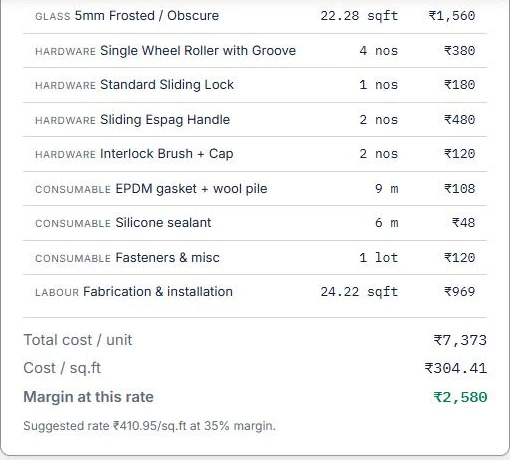
For each window the builder works out 13 cost lines: profile frame, sash and interlock, steel reinforcement, glass, rollers, lock, handles, brush caps, gasket, sealant, fasteners and labour. It shows the cost per square foot, the margin at the current rate, and a suggested rate at a 35% margin.
- Dealer cost panel visible only to the fabricator
- Override the rate per sq.ft and watch the margin change
- Customer sees area, rate per sq.ft and the line total
A branded quotation, ready to send
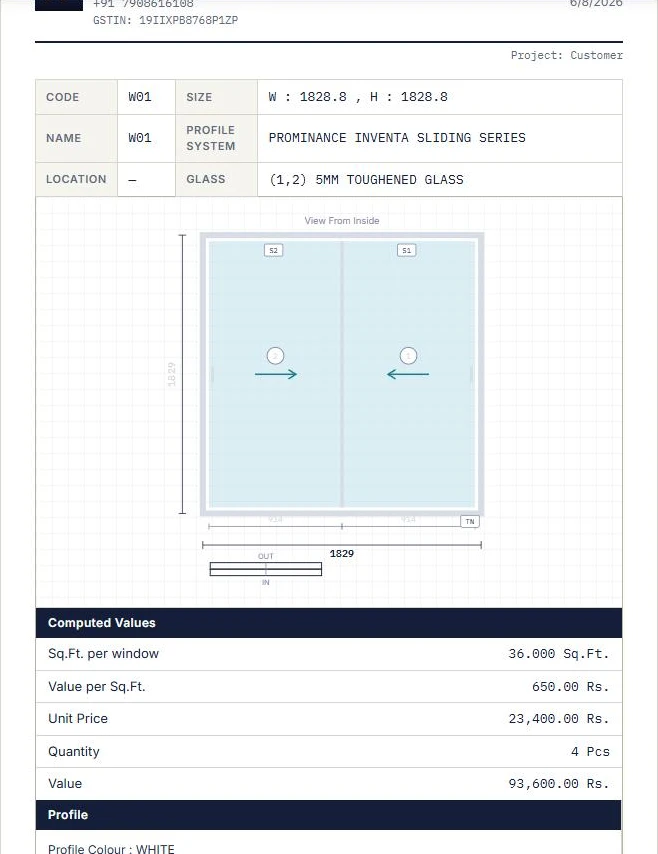
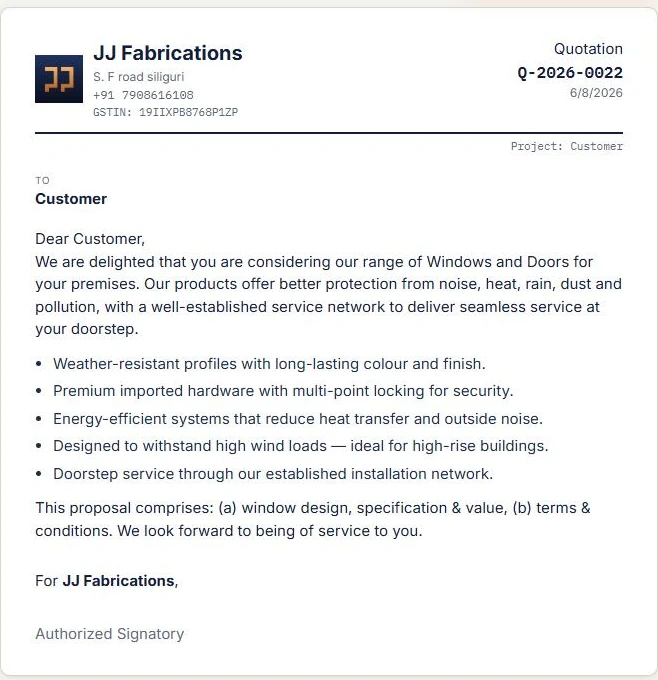
The quotation opens with a cover letter on the fabricator's letterhead, then gives every window its own sheet: code, size, location, profile system, glass, the drawing, the computed values, and the profile and accessory spec. One click prints it or saves it as a PDF.
- Letterhead with address, phone and GSTIN
- Square feet, rate, unit price, quantity and value per window
- Track, sash, reinforcement, lock, handle and roller spelled out
Rate cards that drive every quote
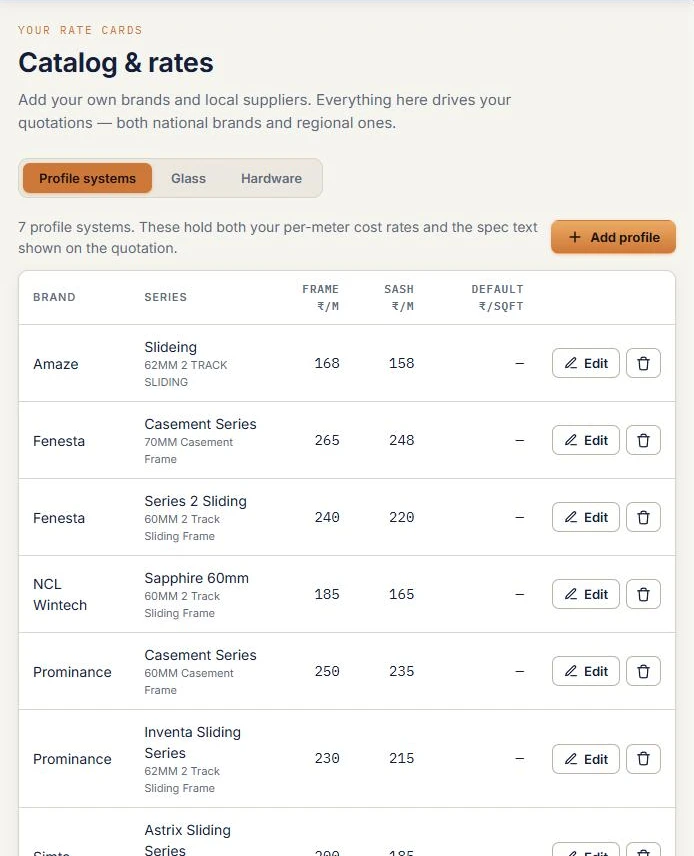
Profile systems, glass and hardware each have their own rate card. Profiles hold the per-metre cost of frame and sash plus the spec text printed on the quotation — national brands and local suppliers side by side.
- Amaze, Fenesta, NCL Wintech, Prominance and Simta series
- Seven glass options, from 4mm clear to DGU toughened
- Lock, roller and handle choices with their own prices
Dashboard
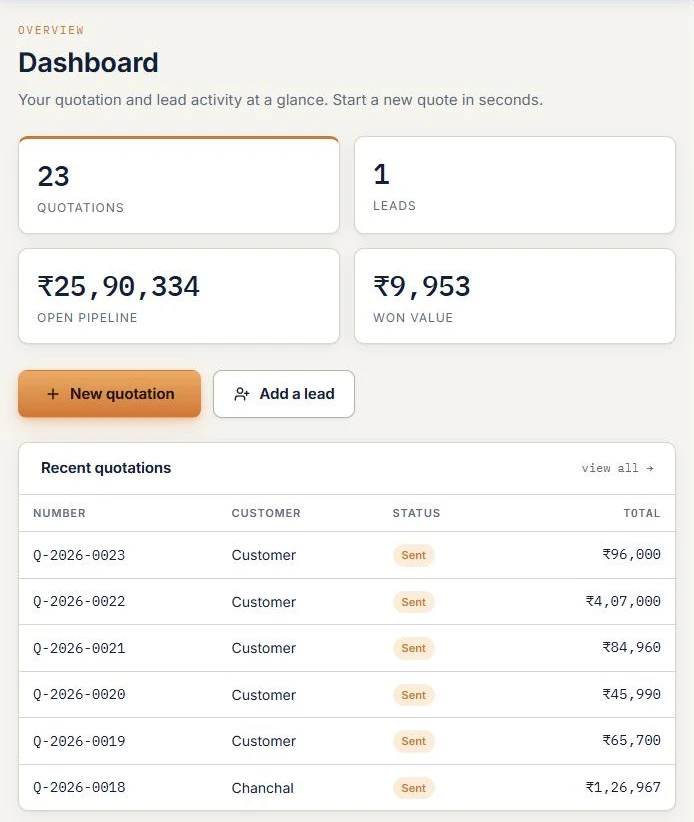
Quotations sent, leads, open pipeline and won value at a glance, with the most recent quotations and their status.
Leads
Every enquiry captured with its source — walk-in, referral, Meta ads, Google, WhatsApp or other — and moved from new to quoted, negotiating, won or lost.
Options per window
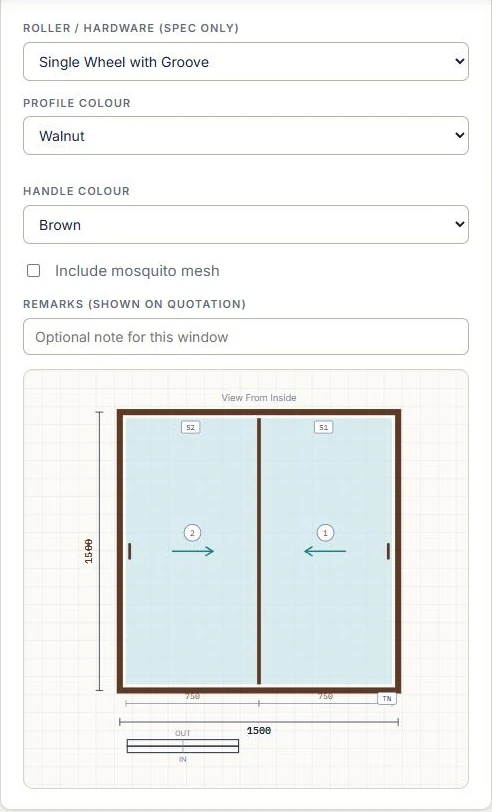
Brand and series, glass, lock, roller, profile colour, handle colour, mosquito mesh and remarks — each one priced or printed where it belongs.
(06) — How It Works
Opening in, quotation out.
Staff enter what they measured and what the customer chose. The rest is calculated.
A 1500 × 1500 mm two-track slider in walnut with 5mm frosted glass, for example, becomes 24.22 sq.ft, ₹7,373 of material and labour, and a suggested ₹410.95 per sq.ft — in the time it takes to pick the options.
(07) — Design Decisions
Choices that make it work on site.
Two prices, two audiences
Cost and margin live in a private dealer panel; the customer only ever sees area and rate per square foot. Sharing a quote is never a risk.
Draw it, don't describe it
A generated elevation with dimensions and sash directions settles questions that a written spec never does.
Suggest a rate, allow an override
The builder proposes a rate at a target margin, and lets the fabricator round it — showing the margin either way.
Designs without code
New window and door shapes are built from rows and cells in the browser, so the library grows with the business.
Rates and designs are data, not code
Because brands, rate cards and the design library are all set up in the app, the same platform can serve another fabricator with their own letterhead and prices — it also runs Clearstone.
(08) — Conclusion
From tape measure to quotation.
Every opening drawn, costed line by line and priced at a known margin — and the customer gets a clear, branded quotation while the fabricator keeps the numbers that matter to themselves.
Gurugram · Plus Offices, Plot 65, Sector 44, Haryana 122003
Siliguri · Jewel Club Lane, Udham Singh Sarani - 734001